
Free shipping starts now, no minimum, no coupons required!

Accessibility

Accessibility Statement

 
Introduction
The internet today constitutes the largest database of free information for all users, including users with disabilities. As such, we place great emphasis on providing equal opportunity for people with disabilities to be able to use the information on our website and enjoy a better browsing experience. 
We aim to ensure that digital services are accessible to people with disabilities, and therefore we have invested large resources in order to simplify the use of the website for people with disabilities as much as possible, out of the belief that every person deserves the right to live with equality, dignity, convenience, and independence. 
 
Using the website accessibility program
This website is run by the accessibility program of the "Accessible with a Click" company and is run via a designated accessibility server. The program allows the website to follow the guidelines for internet content accessibility WCAG 2.0 to level AA. The program is subject to the conditions of use of the manufacturer. Warrantee of use applies to the website owners and/or their representative, including the content displayed in the website, as subject to the conditions of use. 
 
How does accessibility work on the website?

The website has an accessibility menu. Clicking on the menu opens accessibility buttons. After choosing a subject in the menu, waiting time is necessary for the page to upload. 

What is in the menu?


✓ Ability to navigate with the keyboard
✓ Increasing and decreasing the website fonts
✓ Changing color contrast based on dark backgrounds
✓ Changing color contrast based on light backgrounds
✓ Adapting the website to color blind people
✓ Underlining links throughout the website


Clarification

Despite our efforts to enable website browsing for all the website pages, there may be website pages that haven't been made accessible yet or may lack a suitable technical solution.
We are continuing our efforts to enhance the accessibility of the website as much as possible, out of our moral obligation to enable the use of the website for the population as a whole, including people with disabilities. 

Navigation

Alomone Labs Alomone Labs

Order Summary

Home

main

  • Products
    • column
      • New Products
      • All Products
      • Research Areas
      • Select Targets
    • column
      • Ion Channels
      • G-Protein Coupled Receptors
      • Transporters, Exchangers and Pumps
      • Controls
    • column
      • Neurotrophic Factors and Receptors
      • Neural Signaling
      • Cell Imaging Tools
      • Kits & Packs
    • column
      • Guinea Pig Polyclonal Antibodies
      • Multiplex Staining Products
      • Live Cell Imaging Products
      • Live Cell Flow Cytometry Products
  • Free Sample Program
  • Services
    • column
      • Custom Services
      • Online Quotes New
      • Ordering & Shipping
  • Resources
    • column
      • NaV Channels
      • Microglia Markers
      • CaV Channels
      • ASICs
      • nAChR
      • TRPV1
      • NMDA Receptor
      • KCa Channels
    • column
      • Tips
      • Protocols
      • Blog
      • Articles
    • column
      • FAQs and Troubleshooting
      • Citations Search Tool
      • Download Protocol Book
      • Venom-Derived Ion Channel Modulators
  • About
    • column
      • About Alomone Labs
      • Why Alomone Labs?
  • Contact
    • column
      • Contact Us
      • Subscribe – Newsletters and Email Updates
Return to Content
Home › Products › Neural Signaling › Neuronal Adhesion Molecules › Antibodies

Certificate of Analysis

Anti-Contactin-1/CNTN1 (extracellular) Antibody

Neural cell surface protein F3, Glycoprotein GP135, CNTN1

Back to product page SDS

Overview

Cat #: ANR-171
Alternative Name Neural cell surface protein F3, Glycoprotein GP135, CNTN1
Lyophilized Powder yes
Type: Polyclonal
Host: Rabbit
Reactivity: h, m, r
Immunogen
  • Peptide (C)RPDGQHDGKLFSTHK, corresponding to amino acid residues 947-961 of rat Contactin-1 (Accession Q63198). Extracellular, N-terminus.
Accession (Uniprot) Number Q63198
Gene ID 117258
Peptide confirmation Confirmed by amino acid analysis and mass spectrometry.
Homology Mouse – identical; human – 14/15 amino acid residues identical.
Purity Affinity purified on immobilized antigen.
Form Lyophilized powder. Reconstituted antibody contains phosphate buffered saline (PBS), pH 7.4, 1% BSA, 0.05% NaN3.
Isotype Rabbit IgG.
Storage before reconstitution The antibody ships as a lyophilized powder at room temperature. Upon arrival, it should be stored at -20°C.
Reconstitution 25 µl, 50 µl or 0.2 ml double distilled water (DDW), depending on the sample size.
Antibody concentration after reconstitution 0.8 mg/ml.
Storage after reconstitution The reconstituted solution can be stored at 4°C for up to 1 week. For longer periods, small aliquots should be stored at -20°C. Avoid multiple freezing and thawing. Centrifuge all antibody preparations before use (10000 x g 5 min).
Standard quality control of each lot Western blot analysis.
Applications: if, ih, wb
May also work in: ic*, ifc*, ip*, lci*
Western blot
  • Mouse and rat brain lysates; human SH-SY5Y neuroblastoma cell lysate (1:200-1:2000).
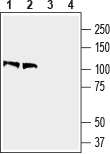
  • Western blot analysis of mouse brain lysate (lanes 1 and 3) and rat brain membranes (lanes 2 and 4):
    Western blot analysis of mouse brain lysate (lanes 1 and 3) and rat brain membranes (lanes 2 and 4):
    1,2. Anti-Contactin-1/CNTN1 (extracellular) Antibody (#ANR-171), (1:200).
    3,4. Anti-Contactin-1/CNTN1 (extracellular) Antibody, preincubated with Contactin-1 (extracellular) Blocking Peptide (#BLP-NR171).
Immunohistochemistry
  • Rat brain sections (1:200).
Scientific background

Contactin-1 (CNTN1), also known as F3/Contactin a cell adhesion molecule, is a glycosylphosphatidylinositol (GPI)-anchored neuronal membrane protein involved in neuronal development, synaptic maintenance and organization of neuronal networks. CNTNs are a subpopulation of molecules belonging to the immunoglobulin (Ig) superfamily, which includes six members: CNTN1, TAG-1/CNTN2, BIG-1/CNTN3, BIG-2/CNTN4, NB-2/CNTN5 and NB-3/CNTN61,2.

In mammals, contactin-1 is mostly localized in the peripheral and central neural system. It is highly expressed at the axonal level and mediates various functions in both glial and neuronal cells; it is involved in neuronal and glial development and differentiation, myelination, synaptogenesis and synaptic function1.

Contactin-1 expression profile differs in various brain regions and, within each area, it changes depending upon the cell type. For example, in the cerebellar cortex contactin-1 is predominant in granule cells in earlier developmental stages, whereas its activation is delayed in Purkinje neurons. In the hippocampus, it is detected on pyramidal neurons of CA1-CA3 fields and in granule layers of Dentate Gyrus (DG) where its expression persists in postnatally developed neurons. Hippocampal contactin-1 is highly expressed in the developing hippocampus, it progressively increases during postnatal life, but it declines during aging, paralleling cognitive impairment. This suggests that contactin-1 might play a role in memory processes, in line with studies indicating its involvement in neurotransmitter release and some forms of plasticity1.

The role of contactin-1 in neurotransmitter release has been linked with its capability to regulate synaptic vesicle exocytosis. Contactin-1 overexpression had been shown to induce an increase of cAMP-Responsive Element Binding (CREB) phosphorylation, enhanced hippocampal-dependent LTP and memory especially in 12-months-old mice, where neurogenesis is particularly evident. Also, contactin-1 overexpression counteracts apoptosis, and induces an increase of the antiapoptotic- and neuroplasticity-pathway BDNF/CREB/Bcl-21,3.

Contactin-1 plays an important role in cancer progression. The expression of contactin-1 is upregulated in primary lesions, and its expression level correlates with tumor metastasis in cancer patients. Studies have demonstrated that contactin-1 also plays a key role in diseases not related to the nervous system, and its most notable function is its participation in cancer progression; in cancers such as esophageal squamous cell carcinoma (ESCC), GC, lung adenocarcinoma, oral squamous cell carcinoma (OSCC), hepatocellular carcinoma and prostate cancer2,3.
Application key:

CBE- Cell-based ELISA, FC- Flow cytometry, ICC- Immunocytochemistry, IE- Indirect ELISA, IF- Immunofluorescence, IFC- Indirect flow cytometry, IHC- Immunohistochemistry, IP- Immunoprecipitation, LCI- Live cell imaging, N- Neutralization, WB- Western blot

Species reactivity key:

H- Human, M- Mouse, R- Rat
Lyophilized Powder
For research purposes only, not for human use
Last Update: 03/01/2024

Specifications

Citations

Citations

Applications

Scientific Background

Specific Control Product

  • Contactin-1 (extracellular) Blocking Peptide (#BLP-NR171) is the original antigen used for immunization during Anti-Contactin-1/CNTN1 (extracellular) Antibody (#ANR-171) generation. The blocking peptide binds and ‘blocks’ Anti-Contactin-1 (extracellular) primary antibody, this makes it a good negative reagent control to help confirm antibody specificity in western blot and immunohistochemistry applications. This control is also often called a pre-adsorption control.

    Contactin-1 (extracellular) Blocking Peptide (#BLP-NR171)

Related Products

Antibodies

  1. Anti-Caspr2 Antibody (#APZ-005)
  2. Anti-CD56/NCAM1 (extracellular) Antibody (#ANR-041)
  3. Anti-CD56/NCAM1 (extracellular)-ATTO Fluor-488 Antibody (#ANR-041-AG)
  4. Anti-NCAM2 (extracellular) Antibody (#ANR-042)
  5. Anti-Neurofascin Antibody (#AIP-025)

General Protocols

  • Blocking Peptides – Controls for better results
  • Blocking Peptide Protocol for Western Blot (WB)
  • Sample Preparation for Cell Lines
  • Immunohistochemistry (IHC) Protocols for Frozen Sections: Indirect Methods
  • Sample Preparation Protocols for Tissues
  • Western Blot (WB) Protocol

Shipping and Ordering Information

Free International Shipping

Products are lyophilized and ship at room temperature - FREE OF CHARGE.

We ship worldwide within 24 hours of our next business day.

For more country-specific shipping and contact information see Ordering & Shipping.


Free Sample Program

Not sure whether the product fits your experimental setup?

Try it first!


Alomone Guarantee

We offer 100% guarantee on all our products. If our products do not perform as stated, please contact our technical support staff.

Alomone Guarantee information

Need Help With This Product?

Our reagent specialists are here to help you find the best product for your application. Please message us and we will be happy to help you find the right product for the job.

Contact Us

Contact Us

Get a 25 µl free sample

Read more about our Free Sample Program

Products

  • Ion Channels
  • G-Protein Coupled Receptors
  • Neurotrophic Factors and Receptors
  • Antibodies
  • Transporters, Exchangers and Pumps
  • Cell Imaging
  • Live Cell Flow Cytometry
  • Multiplex Staining
  • Controls
  • Kits and Packs
Menu
  • Ion Channels
  • G-Protein Coupled Receptors
  • Neurotrophic Factors and Receptors
  • Antibodies
  • Transporters, Exchangers and Pumps
  • Cell Imaging
  • Live Cell Flow Cytometry
  • Multiplex Staining
  • Controls
  • Kits and Packs

Resources

  • FAQ
  • Featured Products
  • Blog
  • Protocols
  • Tips
  • Articles
  • FAQs and Troubleshooting
  • Citation Search Tool
Menu
  • FAQ
  • Featured Products
  • Blog
  • Protocols
  • Tips
  • Articles
  • FAQs and Troubleshooting
  • Citation Search Tool

Services

  • Custom Services
  • Online Quotes
  • Orders & Shipping
Menu
  • Custom Services
  • Online Quotes
  • Orders & Shipping

Contact

Scroll to top

Bulk / Customized order
