Overview
- Peptide (C)EAWVKGVNPKGNST, corresponding to amino acid residues 75-88 of human KCNK16 (Accession Q96T55). 1st extracellular loop.
- Rat pancreas lysate and human PANC-1 pancreas ductal adenocarcinoma cell lysate (1:600-1:3000).
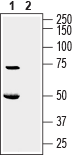 Western blot analysis of rat pancreas lysate:1. Anti-KCNK16 (TALK-1) (extracellular) Antibody (#APC-170), (1:600).
2. Anti-KCNK16 (TALK-1) (extracellular) Antibody, preincubated with KCNK16/TALK-1 (extracellular) Blocking Peptide (#BLP-PC170).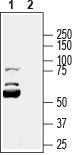 Western blot analysis of human PANC-1 pancreas ductal adenocarcinoma cell line lysate:1. Anti-KCNK16 (TALK-1) (extracellular) Antibody (#APC-170), (1:600).
2. Anti-KCNK16 (TALK-1) (extracellular) Antibody, preincubated with KCNK16/TALK-1 (extracellular) Blocking Peptide (#BLP-PC170).
The KCNK16 gene encodes the TALK-1 channel, an abundant K+ channel transcript found in mouse and in human β-cells. There are four human TALK-1 transcript variants, including two that form functional K+ channels (TALK-1a (transcript variant 2) and TALK1-b (transcript variant 3)1,2. The TALK-1 structure includes 4 transmembrane domains, 2 extracellular loops, and intracellular N- and C-termini. The C-terminal tail of TALK-1 is a critical component that influences the magnitude of TALK-1 channel activation, while the N-terminus is important for protein interaction1,2.
TALK-1, two-pore domain K+ (K2P16.1) channel is responsible for modulating glucose stimulated insulin secretion that relies on β-cell Ca2+ influx. The channel produces outwardly rectifying, non-inactivating K+ currents, which are enhanced by elevations in extracellular pH. TALK-1 is thus pH-sensitive, with increased activity under alkaline conditions. In addition, it can be activated by singlet oxygen and nitric oxide.
A gain-of-function polymorphism in the KCNK16 gene is associated with increased risk for developing type-2 diabetes1,2.