Overview
- GST fusion protein with the sequence
SHSSHSSQSSSKKSSSVHSIPSTANRPNRPKSRESRDKQNATRMTRMGQAEKKWFTDEPDNAYPRNIQIKPMSTHMANQINQYKSTSSLIPPIREVEDEC, corresponding to residues 1097-1196 of mouse KCNMA1 variant 2 (Accession Q08460-2). Intracellular, C-terminus.
- Rat brain membranes (1:200).
 Western blot analysis of rat brain membranes:1. Anti-KCNMA1 (KCa1.1) (1097-1196) Antibody (#APC-021), (1:200).
2. Anti-KCNMA1 (KCa1.1) (1097-1196) Antibody, preincubated with KCNMA1 (KCa1.1) (1097-1196) Blocking Peptide (#BLP-PC021).
- Rat brain lysates (2 μg) (Park, S.M. et al. (2004) FEBS Lett. 570, 143.).
- Rat brain sections.
Mouse vomeronasal sections (Zhang, P. et al. (2008) J. Neurophysiol. 100, 1824.).
- Mouse vomeronasal neurons (Zhang, P. et al. (2008) J. Neurophysiol. 100, 1824.).
The KCa1.1 channel (also known as KCNMA1, BKCa, Maxi K+ or slo) is part of a structurally diverse group of K+ channels that are activated by an increase in intracellular Ca2+. KCa1.1 shows a large single channel conductance when recorded electrophysiologically and hence its name. It differs from the rest of the subfamily members in that it can be activated by both an increase in intracellular Ca2+ and by membrane depolarization. In addition, the KCa1.1 channel structurally differs from the other Ca2+-dependent K+ channels. While the latter group has a topology that resembles that of the voltage-dependent K+ channels, the KCa1.1 channel has an extracellular N-terminus domain as well as an additional transmembrane domain.
KCa1.1 is expressed in virtually all cell types where it causes hyperpolarization and helps to connect intracellular Ca2+ signaling pathways and membrane excitability.
Indeed, KCa1.1 channels play a crucial role in smooth muscle contractility, neuronal spike shaping and neurotransmitter release.
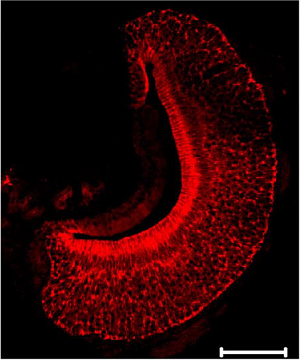 Expression of KCNMA1 (KCa1.1) in mouse VNO sections.Immunohistochemical staining of rat vomeronasal organ (VNO) sections using Anti-KCNMA1 (KCa1.1) (1097-1196) Antibody (#APC-021). KCNMA1 staining (red) is specifically localized to the sensory epithelium with heavy labeling at the apical surface. Adapted from Zhang, P. et al. (2008) J. Neurophysiol. 100, 1824. with permission of The American Physiological Society.