Overview
- Peptide (C)DLDASKESKA(S)VSE, corresponding to amino acid residues 112 - 125 of rat Kir2.1 (Accession Q64273). Extracellular loop.
- Human THP-1 monocytic leukemia cells; mouse J774 macrophage cells (2.5 µg).
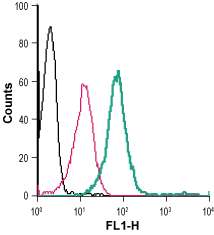 Cell surface detection of Kir2.1 in live intact human THP-1 monocytic leukemia cells:___ Cells.
___ Cells + rabbit IgG isotype control-FITC.
___ Cells + Anti-Kir2.1/KCNJ2 (extracellular)-FITC Antibody (#APC-159-F), (2.5 µg).
Inwardly rectifying K+ (Kir) channels allow K+ to move more easily in, rather than out, of the cell. They have diverse physiological functions depending on their type and their location. There are seven Kir channel subfamilies that can be classified into four functional groups.
Kir2.1 belongs to the Kir2.x subfamily. The primary structure of Kir2.1 is comprised of two putative membrane-spanning domains (TM1 and TM2) linked by an extracellular pore-forming region (H5) and cytoplasmic amino and carboxy terminal domains. The H5 region serves as the “ion-selectivity filter” that is shared with other K+-selective ion channels with the signature sequence T-X-G-Y(F)-G.
Although initially thought to form only homomeric complexes, it is now known that Kir2.1 can function as a heterotetramer with other Kir2.x subunits both in vitro and in vivo.
After synthesis in the endoplasmic reticulum, Kir2.1 is transported to the Golgi apparatus for post-translational modification, and then transported to the cell surface. Sequences in the NH2-terminal region have been identified as responsible for Golgi export.
Kir2.1 is expressed in skeletal and cardiac muscle and contributes to the establishment of highly negative resting potential and long-lasting action potential plateau in various cells including cardiac myocytes. Inward rectification of Kir2.1 is caused by intracellular ions such as Mg2+ and polyamines.
Andersen syndrome is caused by dysfunction of Kir2.1. Patients with Andersen syndrome exhibit cardiac arrhythmias reminiscent of long Q-T syndrome, periodic paralysis, and dysmorphic bone structure in the face and fingers.