
Free shipping starts now, no minimum, no coupons required!

Accessibility

Accessibility Statement

 
Introduction
The internet today constitutes the largest database of free information for all users, including users with disabilities. As such, we place great emphasis on providing equal opportunity for people with disabilities to be able to use the information on our website and enjoy a better browsing experience. 
We aim to ensure that digital services are accessible to people with disabilities, and therefore we have invested large resources in order to simplify the use of the website for people with disabilities as much as possible, out of the belief that every person deserves the right to live with equality, dignity, convenience, and independence. 
 
Using the website accessibility program
This website is run by the accessibility program of the "Accessible with a Click" company and is run via a designated accessibility server. The program allows the website to follow the guidelines for internet content accessibility WCAG 2.0 to level AA. The program is subject to the conditions of use of the manufacturer. Warrantee of use applies to the website owners and/or their representative, including the content displayed in the website, as subject to the conditions of use. 
 
How does accessibility work on the website?

The website has an accessibility menu. Clicking on the menu opens accessibility buttons. After choosing a subject in the menu, waiting time is necessary for the page to upload. 

What is in the menu?


✓ Ability to navigate with the keyboard
✓ Increasing and decreasing the website fonts
✓ Changing color contrast based on dark backgrounds
✓ Changing color contrast based on light backgrounds
✓ Adapting the website to color blind people
✓ Underlining links throughout the website


Clarification

Despite our efforts to enable website browsing for all the website pages, there may be website pages that haven't been made accessible yet or may lack a suitable technical solution.
We are continuing our efforts to enhance the accessibility of the website as much as possible, out of our moral obligation to enable the use of the website for the population as a whole, including people with disabilities. 

Navigation

Alomone Labs Alomone Labs

Order Summary

Home

main

  • Products
    • column
      • New Products
      • All Products
      • Research Areas
      • Select Targets
    • column
      • Ion Channels
      • G-Protein Coupled Receptors
      • Transporters, Exchangers and Pumps
      • Controls
    • column
      • Neurotrophic Factors and Receptors
      • Neural Signaling
      • Cell Imaging Tools
      • Kits & Packs
    • column
      • Guinea Pig Polyclonal Antibodies
      • Multiplex Staining Products
      • Live Cell Imaging Products
      • Live Cell Flow Cytometry Products
  • Free Sample Program
  • Services
    • column
      • Custom Services
      • Online Quotes New
      • Ordering & Shipping
  • Resources
    • column
      • NaV Channels
      • Microglia Markers
      • CaV Channels
      • ASICs
      • nAChR
      • TRPV1
      • NMDA Receptor
      • KCa Channels
    • column
      • Tips
      • Protocols
      • Blog
      • Articles
    • column
      • FAQs and Troubleshooting
      • Citations Search Tool
      • Download Protocol Book
      • Venom-Derived Ion Channel Modulators
  • About
    • column
      • About Alomone Labs
      • Why Alomone Labs?
  • Contact
    • column
      • Contact Us
      • Subscribe – Newsletters and Email Updates
Return to Content
Home › Products › Ion Channels › K+ Channels › Inward Rectifier K+ Channels › Antibodies to Kir Channels

Certificate of Analysis

Anti-Kir2.3 (KCNJ4) Antibody

Inward rectifier potassium channel 4, BIR11, IRK3, HIRK2, HRK1

Back to product page SDS

Overview

Cat #: APC-032
Alternative Name Inward rectifier potassium channel 4, BIR11, IRK3, HIRK2, HRK1
Lyophilized Powder yes
Type: Polyclonal
Host: Rabbit
Reactivity: h, m, r
Immunogen
  • Peptide (C)EFGS HLDLE RMQAA TLPLD N, corresponding to amino acid residues 418-437 of rat Kir2.3 (Accession P52190). Intracellular, C-terminal part.
Accession (Uniprot) Number P52190
Gene ID 116649
Peptide confirmation Confirmed by amino acid analysis and mass spectrometry.
Homology Mouse - identical; guinea pig - 19/20 amino acid residues identical; hamster, human, Xenopus - 18/20 amino acid residues identical.
RRID AB_2040111.
Purity Affinity purified on immobilized antigen.
Form Lyophilized powder. Reconstituted antibody contains phosphate buffered saline (PBS), pH 7.4, 1% BSA, 0.05% NaN3.
Isotype Rabbit IgG.
Storage before reconstitution The antibody ships as a lyophilized powder at room temperature. Upon arrival, it should be stored at -20°C.
Reconstitution 50 μl or 0.2 ml double distilled water (DDW), depending on the sample size.
Antibody concentration after reconstitution 0.8 mg/ml.
Storage after reconstitution The reconstituted solution can be stored at 4°C for up to 1 week. For longer periods, small aliquots should be stored at -20°C. Avoid multiple freezing and thawing. Centrifuge all antibody preparations before use (10000 x g 5 min).
Standard quality control of each lot Western blot analysis.
Applications: ic, if, ih, wb
May also work in: ifc*, ip*
Western blot
  • Rat brain membranes (1:200).

    Human heart lysate (1:200) (Voigt, N. et al. (2010) Circ. Arrhyth. Electrophysiol. 3, 472.).
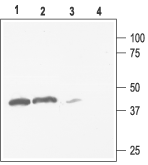
  • Western blot analysis of rat kidney (lanes 1 and 3) and brain (lanes 2 and 4) membranes:
    Western blot analysis of rat kidney (lanes 1 and 3) and brain (lanes 2 and 4) membranes:
    1,2. Anti-Kir2.3 (KCNJ4) Antibody (#APC-032), (1:200)
    3,4. Anti-Kir2.3 (KCNJ4) Antibody, preincubated with Kir2.3/KCNJ4 Blocking Peptide (#BLP-PC032).
Immunohistochemistry
  • Rat brain sections.
Immunocytochemistry
  • Canine ventricle and atrium myocytes (1:300) (Melnyk, P. et al. (2002) Am. J. Physiol. 283, H1123.).
Scientific background

Kir2.3 is a member of the family of inward rectifying K+ channels. The family includes 15 members that are structurally and functionally different from the voltage-dependent K+ channels.

The family’s topology consists of two transmembrane domains that flank a single and highly conserved pore region with intracellular N- and C-termini. As is the case for the voltage-dependent K+ channels the functional unit for the Kir channels is composed of four subunit that can assembly as either homo or heterotetramers.

Kir channels are characterized by a K+ efflux that is limited by depolarizing membrane potentials thus making them essential for controlling resting membrane potential and K+ homeostasis.

Kir2.3 is a member of the Kir2.x subfamily that includes four members (Kir2.1- Kir2.4) that are characterized by strong inward rectification and high constitutive activity.

Kir2.3 is expressed in a variety of tissues including heart and brain. 2

In the heart, Kir2.3 forms heteromers with Kir2.1 and underlay the IK1 current (at least in some species) that is responsible for setting the resting membrane potential, preventing membrane hyperpolarization due to Na+ pump activity, influencing propagation velocity, altering the electrical space constant, and promoting late phase repolarization.1,2
Application key:

CBE- Cell-based ELISA, FC- Flow cytometry, ICC- Immunocytochemistry, IE- Indirect ELISA, IF- Immunofluorescence, IFC- Indirect flow cytometry, IHC- Immunohistochemistry, IP- Immunoprecipitation, LCI- Live cell imaging, N- Neutralization, WB- Western blot

Species reactivity key:

H- Human, M- Mouse, R- Rat
Lyophilized Powder
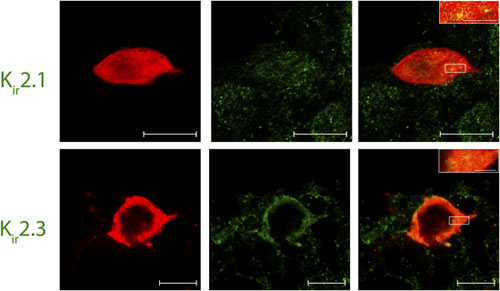
Image & Title: Anti-Kir2.3 (KCNJ4) AntibodyExpression of Kir2.1 and Kir2.3 channels in Lamina I pacemaker cells.Immunohistochemical staining of rat spinal cord sections using Lamina I pacemaker using Anti-Kir2.1 (KCNJ2) Antibody (#APC-026) and Anti-Kir2.3 (KCNJ4) Antibody (#APC-032). Confocal images of representative biocytin-filled pacemaker neurons (red) processed for Kir (green). Merged images demonstrate that immunoreactive puncta for Kir2.1 and Kir2.3 (yellow; inset) are localized to identified pacemaker neurons within lamina I of the neonatal spinal cord (right). Scale bars: 10 μm; inset, 2 μm.Adapted from Li, J. et al. (2013) with permission of The Society for Neuroscience.
For research purposes only, not for human use
Last Update: 03/01/2024

Specifications

Citations

Citations

Applications

Scientific Background

Specific Control Product

  • Kir2.3/KCNJ4 Blocking Peptide (#BLP-PC032) is the original antigen used for immunization during Anti-Kir2.3 (KCNJ4) Antibody (#APC-032) generation. The blocking peptide binds and ‘blocks’ Anti-Kir2.3/KCNJ4 primary antibody, this makes it a good negative reagent control to help confirm antibody specificity in western blot and immunohistochemistry applications. This control is also often called a pre-adsorption control.

    Kir2.3/KCNJ4 Blocking Peptide (#BLP-PC032)

Related Products

Antibodies

  1. Anti-Kir2.1/KCNJ2 Antibody (#APC-026)
  2. Anti-Kir2.2 (KCNJ12) Antibody (#APC-042)

Pharmacological tools

Blockers/Antagonists: small molecules
  1. ML133 hydrochloride (#M-275)

Explorer kits & Research packs

Explorer kits
  1. Kir Channel Antibody Explorer Kit (#AK-200)

Resources

  • K+ Channels in Cardiomyocytes
  • Ion Channels and Pain

Shipping and Ordering Information

Free International Shipping

Products are lyophilized and ship at room temperature - FREE OF CHARGE.

We ship worldwide within 24 hours of our next business day.

For more country-specific shipping and contact information see Ordering & Shipping.


Free Sample Program

Not sure whether the product fits your experimental setup?

Try it first!


Alomone Guarantee

We offer 100% guarantee on all our products. If our products do not perform as stated, please contact our technical support staff.

Alomone Guarantee information

Resources

  • K+ Channels in Cardiomyocytes

  • Ion Channels and Pain

Need Help With This Product?

Our reagent specialists are here to help you find the best product for your application. Please message us and we will be happy to help you find the right product for the job.

Contact Us

Contact Us

Get a 50 µl free sample

Read more about our Free Sample Program

Products

  • Ion Channels
  • G-Protein Coupled Receptors
  • Neurotrophic Factors and Receptors
  • Antibodies
  • Transporters, Exchangers and Pumps
  • Cell Imaging
  • Live Cell Flow Cytometry
  • Multiplex Staining
  • Controls
  • Kits and Packs
Menu
  • Ion Channels
  • G-Protein Coupled Receptors
  • Neurotrophic Factors and Receptors
  • Antibodies
  • Transporters, Exchangers and Pumps
  • Cell Imaging
  • Live Cell Flow Cytometry
  • Multiplex Staining
  • Controls
  • Kits and Packs

Resources

  • FAQ
  • Featured Products
  • Blog
  • Protocols
  • Tips
  • Articles
  • FAQs and Troubleshooting
  • Citation Search Tool
Menu
  • FAQ
  • Featured Products
  • Blog
  • Protocols
  • Tips
  • Articles
  • FAQs and Troubleshooting
  • Citation Search Tool

Services

  • Custom Services
  • Online Quotes
  • Orders & Shipping
Menu
  • Custom Services
  • Online Quotes
  • Orders & Shipping

Contact

Scroll to top

Bulk / Customized order
